
Written by Lucas Hernández
Founder of Financial Boost Guide
Last Updated: July 2026
Reading Time: 8–10 minutes
Financial Boost Guide provides beginner-friendly educational content about investing, personal finance, saving money, and building long-term wealth.
➡️ Learn more about our mission on our About page.
Unexpected expenses, retirement planning, buying a home, or achieving financial freedom all have one thing in common: they require savings.
One of the most common personal finance questions people ask is:
“How much should you save every month?”
Many people wonder how much they should save every month in order to achieve financial security and long-term financial goals.
Unfortunately, there is no single answer that works for everyone.
The amount you should save depends on factors such as your income, expenses, financial goals, age, and lifestyle.
However, there are proven guidelines and savings strategies that can help almost anyone build financial security and long-term wealth.
In this guide, you’ll learn:
- How much you should save every month based on your income
- Popular savings rules used by financial experts
- How to balance saving, investing, and paying off debt
- How to adjust your savings goals at different stages of life
- Common mistakes to avoid when building savings
By the end of this guide, you’ll have a clear framework for deciding exactly how much of your monthly income should go toward savings.
Table of Contents
Why Saving Money Every Month Is Important

Saving money is not just about preparing for emergencies.
Regular saving creates financial stability, reduces stress, and gives you more freedom to make important life decisions.
Without savings, even small unexpected expenses can force people to rely on credit cards or loans, creating long-term financial problems.
Building the habit of saving every month provides several important benefits.
Financial Security
Having money set aside helps protect you from unexpected events such as:
- Medical expenses
- Car repairs
- Home maintenance costs
- Job loss
- Emergency travel expenses
Financial security is one of the main reasons experts recommend saving consistently.
Greater Financial Freedom
Savings provide options.
Whether you want to change careers, start a business, buy a home, or retire early, having savings gives you flexibility and control over your future.
Reduced Financial Stress
Money problems are one of the biggest sources of stress for many people.
Knowing that you have savings available can provide peace of mind and improve your overall financial wellbeing.
The Ability to Invest and Build Wealth
Saving is often the first step toward investing.
Before building an investment portfolio, most financial experts recommend creating an emergency fund and developing a regular savings habit.
Over time, these savings can be invested to generate long-term wealth through compound growth.
Better Financial Habits
Saving every month helps develop discipline and consistency.
The earlier you build strong financial habits, the easier it becomes to manage money effectively throughout your life.
The 50/30/20 Rule for Saving Money
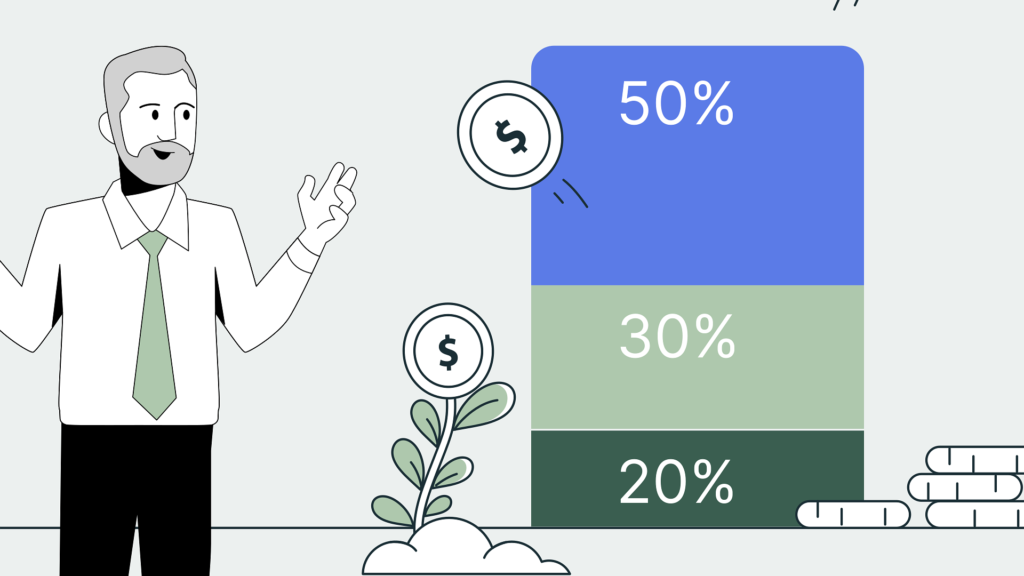
One of the most popular budgeting methods in personal finance is the 50/30/20 rule.
This simple framework helps people balance their spending, savings, and financial goals without creating overly complicated budgets.
The rule divides your after-tax income into three categories:
- 50% for needs
- 30% for wants
- 20% for savings and debt repayment
50% for Needs
This category includes essential expenses that you must pay every month, such as:
- Housing costs
- Utilities
- Groceries
- Transportation
- Insurance
- Minimum debt payments
These expenses should ideally stay below half of your monthly income.
30% for Wants
The wants category covers non-essential spending that improves your lifestyle but is not strictly necessary.
Examples include:
- Dining out
- Entertainment
- Streaming services
- Vacations
- Hobbies
- Shopping
While these expenses are important for maintaining a healthy balance, keeping them under control allows you to save more money.
20% for Savings and Investments
The final 20% is dedicated to improving your financial future.
This money can be used for:
- Building an emergency fund
- Investing for retirement
- Saving for a home deposit
- Paying off debt faster
- Investing in index funds or ETFs
For many people, saving at least 20% of their income provides an excellent starting point for long-term financial success.
Is 20% Always Enough?
Not necessarily.
Some people may need to save more depending on their goals, age, or financial situation.
Others may initially save less while paying off high-interest debt or dealing with temporary financial challenges.
The important thing is to save consistently and increase your savings rate whenever possible.
For many households, the 50/30/20 rule provides a practical answer to the question of how much should you save every month.
How Much Should You Save Every Month Based on Your Income?
While the 20% rule works well for many people, the ideal amount to save each month often depends on your income and financial goals.
The important thing is not necessarily the exact amount you save but developing the habit of saving consistently.
The answer to how much should you save every month depends heavily on your income, expenses, and financial objectives.
| Monthly Income | 10% Savings | 15% Savings | 20% Savings |
|---|---|---|---|
| $2,000 | $200 | $300 | $400 |
| $4,000 | $400 | $600 | $800 |
| $6,000 | $600 | $900 | $1,200 |
| $8,000 | $800 | $1,200 | $1,600 |
Here are some general guidelines:
If You Earn $2,000 Per Month
A monthly savings target of:
- 10% = $200 per month
- 15% = $300 per month
- 20% = $400 per month
Even saving $100 to $200 per month can create significant financial security over time.
If You Earn $4,000 Per Month
A monthly savings target of:
- 10% = $400 per month
- 15% = $600 per month
- 20% = $800 per month
At this income level, many people are able to balance saving, investing, and debt repayment simultaneously.
If You Earn $6,000 Per Month
A monthly savings target of:
- 10% = $600 per month
- 15% = $900 per month
- 20% = $1,200 per month
Higher incomes often provide more flexibility to accelerate financial goals such as retirement planning or home ownership.
If You Cannot Save 20%
Do not worry if saving 20% feels impossible right now.
Many people start with:
- 5%
- 7%
- 10%
The key is to start somewhere and gradually increase your savings rate over time.
Saving $100 every month is infinitely better than waiting for the perfect moment to start saving.
Focus on Consistency Rather Than Perfection
Financial success rarely comes from making one huge decision.
Instead, it usually comes from making small, consistent decisions month after month and year after year.
The earlier you begin saving regularly, the more time your money has to grow and work for you.
Savings Goals by Age
One of the most common questions people ask is whether they are saving enough for their age.
While everyone’s financial situation is different, general benchmarks can help you evaluate your progress and identify areas for improvement.
Remember that these figures are guidelines rather than strict rules.
In Your 20s
Your twenties are often focused on building financial habits and creating a solid foundation.
At this stage, priorities usually include:
- Building an emergency fund
- Paying off high-interest debt
- Starting retirement contributions
- Learning basic investing principles
Many financial experts recommend aiming to save at least one year’s salary by age 30.
Several retirement studies and financial institutions use similar benchmarks when evaluating long-term savings progress.
In Your 30s
During your thirties, income often increases alongside financial responsibilities such as mortgages, children, and larger expenses.
Common goals include:
- Increasing retirement contributions
- Building investment portfolios
- Saving for children’s education
- Purchasing a home
A common benchmark is to have between one and three times your annual salary saved by age 40.
In Your 40s
Your forties are often considered critical wealth-building years.
Many people focus on:
- Maximizing retirement savings
- Reducing debt
- Increasing investments
- Preparing for future healthcare costs
Financial experts often recommend having approximately three to six times your annual salary saved by age 50.
In Your 50s
As retirement approaches, saving often becomes an even higher priority.
Common objectives include:
- Eliminating remaining debt
- Increasing retirement contributions
- Reviewing investment allocations
- Planning retirement income strategies
Many retirement planners suggest having six to eight times your annual salary saved by age 60.
In Your 60s and Beyond
At this stage, the focus often shifts from accumulation to preservation and income generation.
Your financial strategy may include:
- Managing retirement withdrawals
- Protecting assets
- Reducing investment risk
- Planning estate transfers
The exact amount you need will depend heavily on your expected retirement lifestyle and spending habits.
Avoid Comparing Yourself to Others
Everyone’s financial journey is different.
Income, location, career choices, family circumstances, and life events all influence saving capacity.
The most important comparison is not with other people, but with your own progress over time.
Your age can influence how much you should save every month, especially when planning for retirement.
How to Save More Money Every Month

If you are struggling to save money consistently, small changes in your financial habits can make a surprisingly large difference over time.
The goal is not necessarily to make dramatic sacrifices but to create a sustainable system that allows you to save automatically every month.
Automate Your Savings
One of the most effective strategies is to automate your savings.
By setting up an automatic transfer to your savings account every payday, you remove the temptation to spend the money elsewhere.
Many people follow the principle:
“Pay yourself first.”
Saving becomes much easier when it happens automatically.
Track Your Spending
You cannot improve what you do not measure.
Tracking your expenses helps identify areas where money may be leaking from your budget without you realizing it.
Even small daily expenses can add up significantly over the course of a year.
Reduce Unnecessary Expenses
Review subscriptions, memberships, and discretionary spending regularly.
Common areas where people save money include:
- Streaming subscriptions
- Dining out
- Takeaway meals
- Impulse purchases
- Premium services that are rarely used
Cutting just a few unnecessary expenses can free up hundreds of dollars each month.
Increase Your Income
While reducing expenses is important, increasing your income can often have an even bigger impact.
Options may include:
- Freelancing
- Overtime work
- Side businesses
- Selling unused items
- Developing new skills
Additional income can accelerate your savings goals dramatically.
Save Windfalls and Bonuses
Tax refunds, bonuses, gifts, and unexpected income provide excellent opportunities to boost savings quickly.
Instead of increasing spending, consider allocating a large portion of these funds toward your financial goals.
Increase Your Savings Rate Gradually
If saving 20% feels impossible today, start smaller.
Saving 5% this year and increasing it to 10% next year is still excellent progress.
Consistency matters far more than perfection when building long-term wealth.
How to Save More Money Every Month
If you are struggling to save money consistently, small changes in your financial habits can make a surprisingly large difference over time.
The goal is not necessarily to make dramatic sacrifices but to create a sustainable system that allows you to save automatically every month.
Automate Your Savings
One of the most effective strategies is to automate your savings.
By setting up an automatic transfer to your savings account every payday, you remove the temptation to spend the money elsewhere.
Many people follow the principle:
“Pay yourself first.”
Saving becomes much easier when it happens automatically.
Track Your Spending
You cannot improve what you do not measure.
Tracking your expenses helps identify areas where money may be leaking from your budget without you realizing it.
Even small daily expenses can add up significantly over the course of a year.
Reduce Unnecessary Expenses
Review subscriptions, memberships, and discretionary spending regularly.
Common areas where people save money include:
- Streaming subscriptions
- Dining out
- Takeaway meals
- Impulse purchases
- Premium services that are rarely used
Cutting just a few unnecessary expenses can free up hundreds of dollars each month.
Increase Your Income
While reducing expenses is important, increasing your income can often have an even bigger impact.
Options may include:
- Freelancing
- Overtime work
- Side businesses
- Selling unused items
- Developing new skills
Additional income can accelerate your savings goals dramatically.
Save Windfalls and Bonuses
Tax refunds, bonuses, gifts, and unexpected income provide excellent opportunities to boost savings quickly.
Instead of increasing spending, consider allocating a large portion of these funds toward your financial goals.
Increase Your Savings Rate Gradually
If saving 20% feels impossible today, start smaller.
Saving 5% this year and increasing it to 10% next year is still excellent progress.
Consistency matters far more than perfection when building long-term wealth.
Frequently Asked Questions
Is saving 20% of your income enough?
For many people, saving 20% of their income is an excellent target and aligns with the popular 50/30/20 budgeting rule.
However, the ideal savings rate depends on your financial goals, age, lifestyle, and retirement plans.
Some people may need to save more, while others may initially save less due to debt repayment or temporary financial challenges.
What if I cannot save money every month?
If saving every month feels impossible, start with small amounts.
Even saving $25 or $50 per month helps build the habit of saving and creates financial momentum.
As your income increases or your expenses decrease, you can gradually increase your savings contributions.
Should I save money or pay off debt first?
In most cases, building a small emergency fund while paying off high-interest debt is the best approach.
Having emergency savings can prevent you from relying on credit cards or loans when unexpected expenses arise.
Where should I keep my savings?
Emergency funds should usually be kept in easily accessible accounts such as high-yield savings accounts.
Long-term savings goals may benefit from investments such as index funds, ETFs, or retirement accounts.
How much should I have saved by age 30?
Many financial experts recommend having approximately one year’s salary saved by age 30.
However, personal circumstances vary significantly, and the most important factor is maintaining consistent progress over time.
Is investing better than saving?
Saving and investing serve different purposes.
Savings provide liquidity and protection against emergencies, while investing aims to grow wealth over the long term.
Most healthy financial plans include both saving and investing.
Conclusion
There is no perfect number that everyone should save every month.
The right amount depends on your income, expenses, financial goals, and stage of life.
However, one principle remains true for almost everyone:
Saving consistently matters more than saving perfectly.
Whether you start with 5%, 10%, or 20% of your income, building the habit of saving every month is one of the most powerful financial decisions you can make.
Over time, regular savings can help you:
- Build an emergency fund.
- Reduce financial stress.
- Invest for the future.
- Achieve major life goals.
- Create long-term financial freedom.
The earlier you start, the more time your money has to grow and work for you.
Remember that personal finance is not about perfection.
It is about progress.
Even small monthly contributions can lead to significant results over the long term.
The best amount to save every month is the amount that allows you to remain consistent while continuing to enjoy your life and work toward your financial goals.
Ultimately, deciding how much should you save every month is a personal decision that should align with your financial goals and lifestyle.
Start where you are, save what you can, and increase your savings rate whenever possible.
Your future self will thank you for it.
About the Author
Lucas Hernández is the founder of Financial Boost Guide, a website dedicated to making investing and personal finance easier to understand for beginners.
He creates practical, well-researched guides that help readers build better financial habits, understand investing with confidence, and make informed financial decisions.
Every article is written with a focus on clarity, accuracy, and long-term educational value.
➡️ Learn more about Lucas and our editorial process on the About page.
Disclaimer: The information provided in this article is for educational purposes only and should not be considered financial, investment, legal, or tax advice. Always conduct your own research or consult a qualified professional before making financial decisions.